

Much of the debate around text and data mining (TDM), has focused on a perceived trade-off between technology companies and some license holders. That is an important discussion—but it is far from the whole story.
It is widely accepted that AI and digital technologies are vital for the UK’s future. Every business sector and public service has plans to innovate based on the application of AI and digital technology.
The UK Government’s Industrial Strategy (Invest 2035) points this out saying that AI and digital technology can boost productivity—by up to 1.5% annually—across strategic sectors like life sciences, financial services, and advanced manufacturing.
If this were to be achieved the UK would see its growth rate rise enough to meaningfully ease many of the major political problems we face – such as tight public spending budgets, the national debt and low living standards.
Given the intense debate over TDM we wanted to understand the extent to which it plays a role in UK businesses’ plans to innovate and stay competitive with AI and digital technology.
Our findings show that the UK’s choice over text and data mining goes much further than the narrow debate between tech companies and license holders. This decision is about the future competitiveness of the entire UK economy, British business’s ability to innovate and whether the UK’s Industrial Strategy will succeed.
What we did
Public First, commissioned by Microsoft, set out to examine how TDM is used across the economy and what different policy choices could mean for growth. To do this, we combined:
- A nationally representative survey of 1,000 UK businesses, including deep dives into financial services and life sciences—two of the UK’s key industrial strategy sectors.
- A task-based economic model estimating how four plausible policy scenarios could affect AI adoption and its contribution to GDP by 2035.
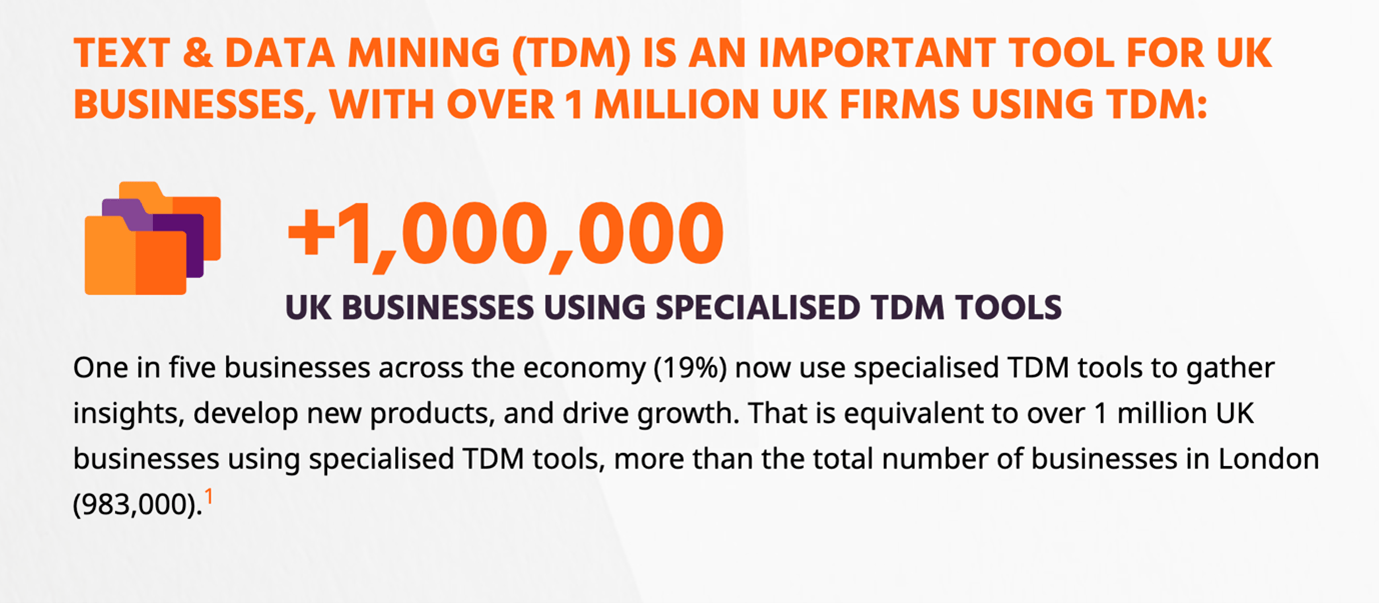
Our research shows that the stakes are huge. We estimate that around a million UK businesses are currently using text and data mining, with this number likely to grow over the next two to three years.
AI adoption could add £510 billion to the UK economy by 2035, but up to £220 billion of this could be lost if we don’t get the right rules in place that allow businesses to use AI to its full potential.
This would mean an economic hit equivalent to total NHS spending in 2024/25 or losing Scotland’s entire economy, including oil and gas revenues.
What British businesses told us:
AI and TDM are already part of everyday business life. Three-quarters of UK businesses have used AI tools at least once, and almost one in five (19%) use specialised TDM tools to analyse large datasets.
TDM use appears across the economy, and in strategic sectors TDM usage is much higher. 34% of life sciences firms and 33% of financial services firms are actively mining and analysing data to stay competitive.
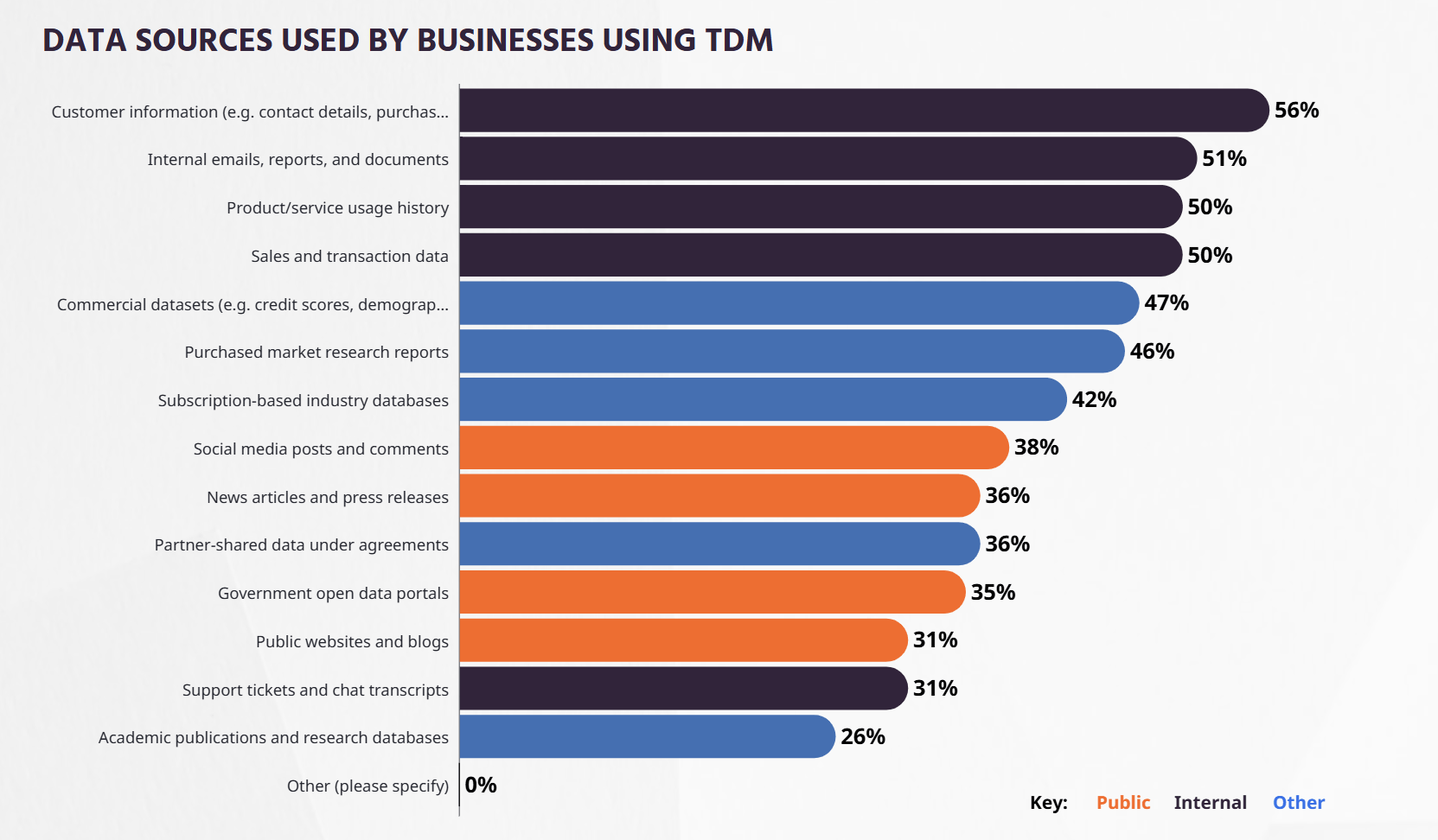
Businesses rely on data – and lots of it: companies using TDM draw on a mix of internal sources (customer records, transaction data, clinical notes) and external sources (market feeds, research databases, news, and public websites).
74% of TDM users say external data is essential to their business, even more than internal data. This matters because access to diverse, data from a wide range of sources underpins the innovation and insight that businesses need.
Without it, AI tools cannot learn or adapt. With it, businesses can innovate and become more competitive, for instance through accelerating drug discovery, better detecting fraud, and creating entirely new products and services.
TDM use is only going to grow: over half of UK businesses want to move from basic to advanced integration of AI and cloud technologies within the next 2–3 years. In life sciences, that figure rises to 65%.
As companies scale up their use of AI, demand for data and the importance of complex analytics will only increase. Clarity on the rules governing the use of TDM will give them the confidence to press ahead, while restrictive rules would limit this growth potential.
Over a third of TDM users (39%) said that legal uncertainty was holding them back from further AI innovation.
The Stakes for the UK economy
Our modelling shows what is at risk. Under the most innovation-friendly scenario – a full commercial TDM exemption – AI adoption could contribute £510 billion to UK GDP by 2035.
However, under the most restrictive scenario – where licences are required for all copyrighted content – that figure falls to £290 billion, a loss of £220 billion or 43% of the potential gain that AI adoption could bring to the UK economy.
Even under a scenario that mirrors the EU’s approach, the UK would lose £60 billion compared to the most optimistic outcome, roughly equivalent to losing the UK’s entire defence budget in 2025/26.
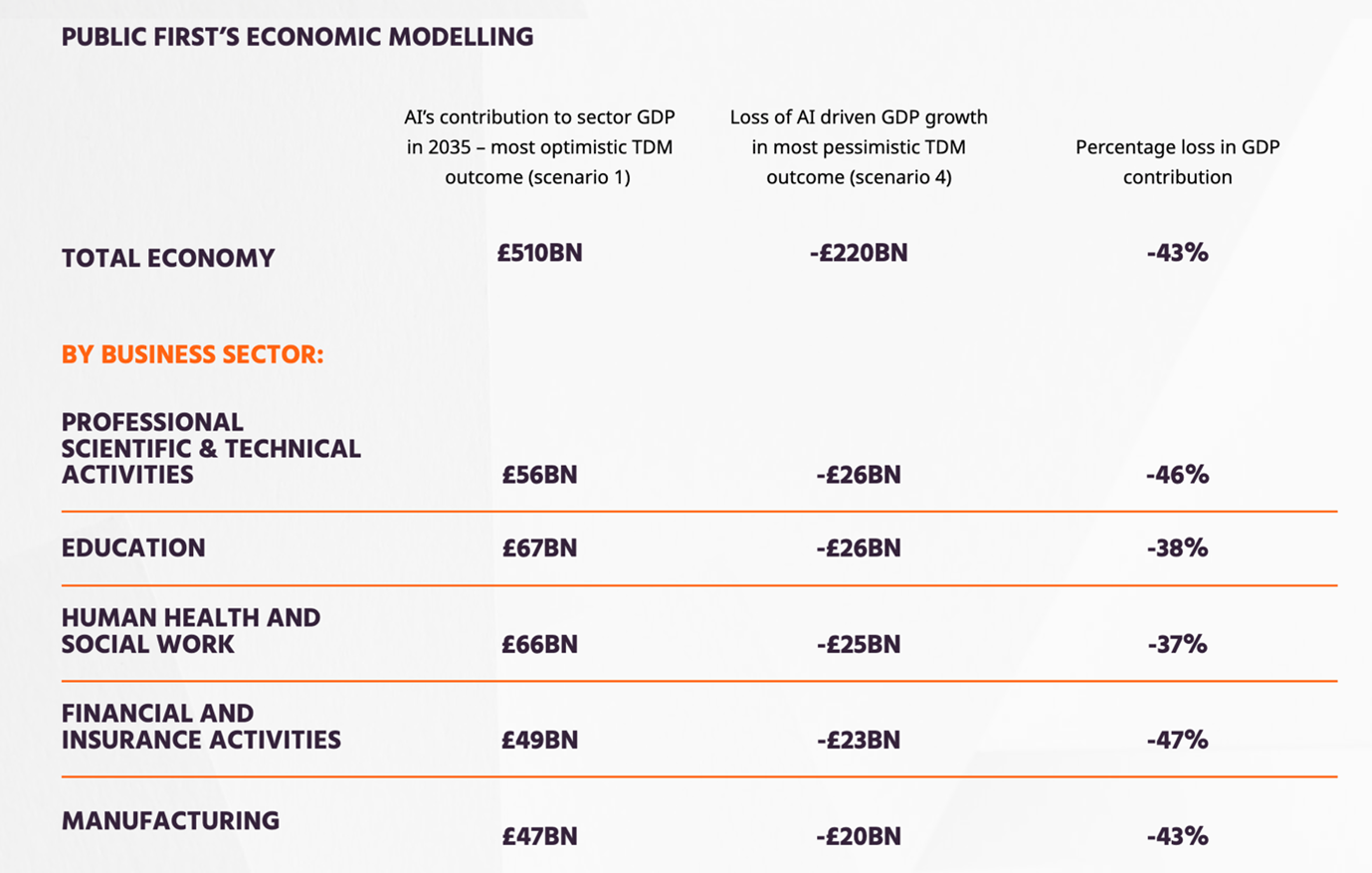
These losses are not abstract – they represent slower growth across all economic sectors like education, manufacturing and in the creative industries. In life sciences alone, up to £26 billion of potential GDP could be at risk; in financial services, up to £23 billion and in manufacturing up to £20bn.
The UK has already fallen behind
Other countries have already made this decision. Japan, Singapore and the EU have already allowed TDM for commercial purposes. The UK has fallen behind, and unless we catch up our businesses here will face higher costs, greater legal uncertainty, and delayed access to cutting-edge AI models. In the worst case, companies could relocate their AI or data analytics functions overseas.
A Debate That Needs Evidence
The discussion around TDM and copyright is often framed as a zero-sum game between rights holders and tech firms.
Our research shows us that this is just a small part of a much bigger picture. Whether the UK proceeds with a commercial exemption for text and data mining is a major issue for all UK businesses – and particularly for the sectors that the Government has identified in its industrial strategy as playing an outsized role in Britain’s growth and prosperity over the next decade.
Our Recommendations
To maximise the potential of AI, text and data mining and the benefits it can drive for UK businesses, the UK Government should:
- Take a pro-data availability approach creating a commercial TDM exemption and designing policy to match global best practice, taking inspiration from Japan and Singapore.
- Introduce enabling regulation quickly, as businesses prepare to scale up AI and text and data mining use.
- Champion pro-data availability policies, through proven tools like regulatory sandboxes, and encourage regulators to adopt a pro‑growth approach to data use.
You can read our full research here.